


Malaria
Plasmodium parasites carried by Anopheles. Transmission is highly sensitive to rainfall and temperature — the anchor of climate-health research in the region.
CAMMISA unites mathematical modellers, climate scientists, entomologists, epidemiologists and health economists across eight institutions and five countries — building a shared picture of how a changing climate reshapes malaria, dengue and chikungunya.
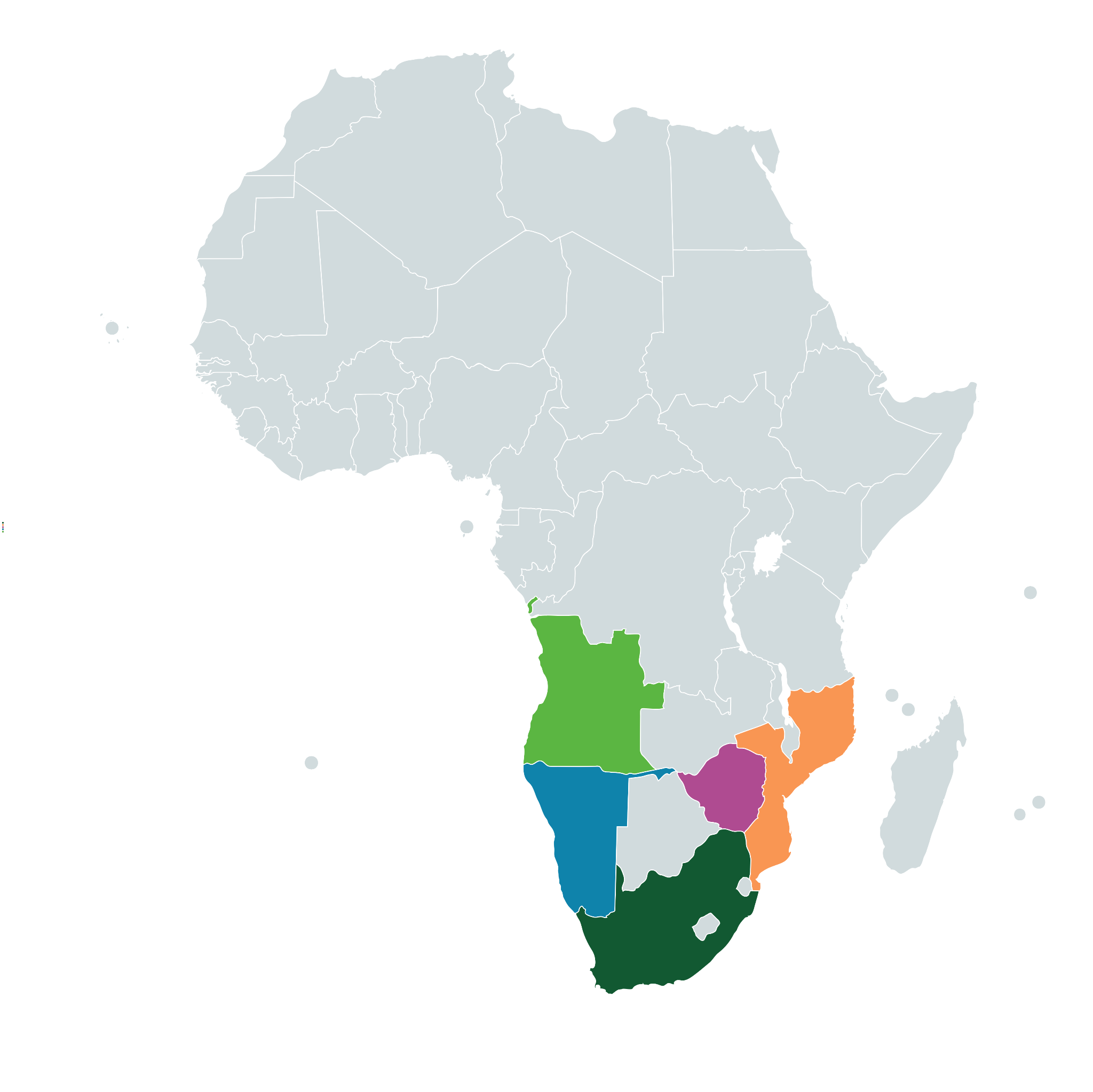
Hover a country to see its partner institutions.
Funded by the Wellcome Trust as part of the initiative Strengthening Health and Disease Modelling for Public Health Decision Making in Africa. Led by the Modelling and Simulation Hub, Africa (MASHA) at the University of Cape Town.
In Southern Africa, malaria is transmitted by Anopheles mosquitoes, while dengue and chikungunya are spread mainly by Aedes aegypti. Yet data on the latter two remains scanty — even as chikungunya outbreaks are reported elsewhere on the continent.
Rising temperatures, shifting rainfall, rapid urbanisation and population movement are changing where these diseases can spread. Without a single resource to understand that risk, planning for it is difficult. CAMMISA is building the evidence base.
“Climate change impacts the transmission of diseases such as malaria, chikungunya and dengue — and those effects vary with the seasons.”
Plasmodium parasites carried by Anopheles. Transmission is highly sensitive to rainfall and temperature — the anchor of climate-health research in the region.
A rapidly urbanising threat spread by Aedes aegypti, with outbreaks increasingly linked to extreme weather across urban and peri-urban settings.
Spread by Aedes aegypti and Ae. albopictus, extending its range as warming temperatures open new suitable habitats across the region.
Led by local modellers and analysts working alongside decision-makers, CAMMISA combines climate science, entomology and mathematical modelling across eleven work packages — turning scattered data into scenarios that guide action.
Linking temperature, rainfall, humidity and soil moisture to transmission — and building experimental short-term and decadal forecasts for the region.
Quantifying how mosquito density, lifespan, biting rate and transmission efficiency vary across the region's distinct climate zones.
Climate-sensitive transmission models and health-economics methods that estimate the future impact and cost of interventions under different scenarios.
From ordering insecticide before a season to planning decades ahead, CAMMISA designs scenarios matched to real decision windows.
Short-term climate forecasts let programmes time indoor residual spraying and insecticide-treated net distribution ahead of each season — adapting a South African forecasting model for the wider region.
Experimental decadal forecasts feed integrated disease-and-economic models, producing counterfactual baselines and intervention scenarios that weigh the health impact and cost of strategies over a five-to-ten-year horizon.
Multidecadal scenarios assess how climate change reshapes environmental receptivity, disease outcomes and the economics of control — the evidence needed to open long-term policy discussions today.
Everything CAMMISA publishes is listed here — journal articles, preprints, reports for national programmes, and the data and code behind them.
Peer-reviewed research across the work packages.
Early findings posted before peer review, so results reach the region sooner.
Short outputs written for national malaria programmes and regional bodies.
Model code, climate datasets and documentation released alongside each paper.
Building a framework to align each work package with real user needs.
A consolidated review of epidemiology, entomology, climate drivers and policy.
Consortium members meet to agree governance, contributions and the five-year plan.
We welcome collaboration with researchers, decision-makers and partners across the region. Get in touch or subscribe for consortium updates.